






























Không gì nguy hiểm hơn bạn bè ngu dốt; tôi thà có kẻ thù khôn.
Nothing is as dangerous as an ignorant friend; a wise enemy is to be preferred.
La Fontaine
Vietnamese Commandos' Hearing History Document
HONORING FORMER SOUTH VIETNAMESE ARMY COMMANDOS
(House of Representatives - May 21, 1998)
[Page: H3733] GPO's PDF
(Ms. SANCHEZ asked and was given permission to address the House for 1 minute and to revise and extend her remarks.)
Ms. SANCHEZ. Mr. Speaker, 2 weeks ago the House Committee on National Security unanimously approved my amendment to honor and recognize the former South Vietnamese army commandos who were employees of the United States Government during the Vietnam War.
Today, the Members of this House had the opportunity to properly honor those brave men by supporting the Department of Defense authorization bill for fiscal year 1999.
Last year, the President signed into law legislation that I advocated to ensure that the United States Government honor a 30-year-old bad debt and pay these men who worked for the United States Government the wages they earned but were denied during the Vietnam War.
These individuals were trained by the Pentagon to infiltrate and destabilize communist North Vietnam.
Many of these commandos were captured and tortured while in prison for 15 to 20 years, and many never made it out.
Declassified DOD documents showed that U.S. officials wrote off the commandos as dead even though they knew from various sources that many were alive in Vietnamese prisons.
The documents also show that U.S. officials lied to the soldiers' wives, paid them tiny `Death Gratuities' and washed their hands of the matter.
For example, Mr. Ha Van Son was listed as dead by our Government in 1967, although he was known to be in a communist prison in North Vietnam. Today he is very much alive and well and living in Chamblee, GA. In my hand I hold the United States Government's official declaration of his death.
Because it was a secret covert operation, the U.S. Government thought they could easily ignore the commandos, their families, friends, and their previous contacts without anyone noticing.
As the Senior Senator from Pennsylvania said in a recent hearing, `This is a genuinely incredible story of callous, inhumane, and really barbaric treatment by the United States.'
In the 104th Congress, this House approved legislation that required the Department of Defense to pay reparations to the commandos.
This bill would have provided $20 million to the commandos and their survivors, an average grant of about $40,000 per commando. It called them to be paid $2,000 a year for every year they were in prison, less than the wages they were due.
President Clinton signed this legislation into law (Public Law 104-201).
However, in April of 1997, the Department of Defense said that the statute was legislatively flawed and the Secretary could not legally make payments.
I then contacted Secretary Cohen requesting the administration's help to correct this error.
The administration responded by supporting inclusion of the funding in the Supplemental Appropriations Bill for fiscal year 1997 (Public Law 105-18)
Last year, I met at a public forum with 40 commandos from my district.
One individual shared with me his story of how he parachuted into enemy territory, was captured, convicted of treason, beaten, thrown into solitary confinement for 11 months, then moved among hard--labor camps for the next seven years.
His story is not unlike countless others. I request unanimous consent to insert into the record one story of this abuse headlined `Uncommon Betrayal' as reported by an Atlantia newspaper recently.
Today, however, I am pleased to provide this Body with this update.
To date, the Commando Compensation Board has been established at the Pentagon; 266 claims have been processed; 142 Commandos have been paid.
All this was made possible because of the commitment of this House.
After years of torture by the North Vietnamese, the callousness of being declared dead by the United States Government, and years of anguish over not receiving their rightful compensation--these brave men now deserve recognition.
The South Vietnamese Lost Army Commandos are finally a step closer to having the United States Government honor their contracts for their years of service to the United States Army.
I am proud that the members of the House had an opportunity to properly honor these brave men
We can not bring those who perished back, but we can give these individuals the dignity and respect that's been so long overdue.
Who supports this resolution?
The State of California American Legion strongly endorses this amendment and I would like to submit the letter from the Department Commander Frank Larson into the Record.
In Commander Larson's letter dated May 1, 1998, he states, `Ms. Sanchez: I'm sure if history were unfolded for all to see it would show that the South Vietnamese commandos, who aided the United States Government in covert actions against the North Vietnamese, were responsible for saving many American lives.'
It goes on to say: `To that end, the same recognition due our soldiers, sailors, marines and airman involved in the Vietnamese Conflict should be afforded to the former South Vietnamese commandos, who so gallantly served and endured.'
It is also supported by: The Air Commando Organization; The Special Forces Organization.
American veterans who fought side by side with the Commandos, come to their defense in
letters of support.
I would like to share with you what our soldiers have to say about the commandos.
This letter comes from a special forces NCO:
`Dear Sir: I had the opportunity to work with these men in which they not only risked their lives, but continually put themselves in harms way. * * * We are aware of terrible trials and conditions these men endured for so long and we would like to help * * *'
I would also like to take this opportunity to mention that last year, during POW/MIA recognition day, I had the opportunity to meet with several members of my veteran community.
I had the opportunity to speak with former POWs and family members whose loved ones were taken as prisoners or declared missing in action. Several of the veterans mentioned their support for the Commandos and urged that the Government honor its word.
Today, we gave these commandos what they really wanted, the distinction of honoring their service in the Vietnam War. And on behalf of the 40 commandos residing in the 46th Congressional District of California, I would like to thank the Members of this body for their commitment to honor and to recognize the former South Vietnamese army commandos.
Mr. Speaker, I submit for the Record a series of documents relating to these former South Vietnamese commandos.
[Page: H3734] GPO's PDF
|
[Federal Register: December 10, 1998 (Volume 63, Number 237)]
[Rules and Regulations]
[Page 68194-68197]
From the Federal Register Online via GPO Access [wais.access.gpo.gov]
[DOCID:fr10de98-15]

=======================================================================
-----------------------------------------------------------------------

DEPARTMENT OF DEFENSE

Office of the Secretary

32 CFR Part 270

RIN 0790-AG67


Compensation of Certain Former Operatives Incarcerated by the
Democratic Republic of Vietnam

AGENCY: Office of Under Secretary of Defense for Personnel and
Readiness, DoD.

ACTION: Interim final rule.

-----------------------------------------------------------------------

SUMMARY: This rule amends part 270 to reflect changes necessary as a
result of new language in Section 658 of the FY99 National Defense
Authorization Act. Section 658 expands the field of beneficiaries of
the Vietnamese Commandos Compensation Commission to parents and
siblings of deceased Commandos. It also adds words ``notwithstanding
any agreement (including a power of attorney) to the contrary, the
actual disbursement'' must be made directly to the person who is
eligible for the payment. This rule also amends part 270 to reflect
necessary technical changes to accommodate the new language.

EFFECTIVE DATE: This rule is effective October 17, 1998. Comments are
requested by February 8, 1999.

ADDRESSES: Forward comments to Commission on Compensation, Office of
the Secretary of Defense, 4000 Defense Pentagon, Washington, DC 20301-
4000.

FOR FURTHER INFORMATION CONTACT: Mr. Chuck Witschonke, (703) 693-1059
or LTC Frank Hudson, (703) 588-6570.

SUPPLEMENTARY INFORMATION:

Executive Order 12866, ``Regulatory Planning and Review''

    It has been determined that this is not a significant rule as
defined under section 3(f)(1) through 3(f)(4) of Executive Order 12866.

Public Law 96-354, ``Regulatory Flexibility Act'' (5 U.S.C. 601)

    It has been determined that this rule will not have a significant
economic impact on a substantial number of small entities because it
affects only a limited

[[Page 68195]]

number of Vietnamese Commandos who were incarcerated in North Vietnam,
and as such, does not affect small entities.

Public Law 96-511, ``Paperwork Reduction Act'' (44 U.S.C. Chapter
35)

    It has been certified that this rule does not impose reporting and
recordkeeping requirements under the Paperwork Reduction Act of 1995.
The reporting and recordkeeping requirements are exempt from this Act,
as it directly involves active litigation in which the U.S. is a party.
    The specific exemption from the Paperwork Reduction Act is found in
5 CFR Part 1320. The information collection in this interim final rule
is exempt from OMB approval under Sec. 1320.4(a)(2), ``Controlling
Paperwork Burdens on the Public; Regulatory Changes Reflecting
Recodification of the Paperwork Reduction Act''.

Public Law 104-4, ``Unfunded Mandates Report Act of 1995 (UMRA)''

    It has been determined that this rule does not contain a federal
mandate that may result in expenditures of $100 million or more for
state, local, and tribal governments, in the aggregate, or the private
sector in any one year.

List of Subjects in 32 CFR Part 270

    Military personnel, Payments, Prisoners of war, Vietnam.

    Accordingly, 32 CFR part 270 is amended to read as follows:

PART 270--[AMENDED]

    1. The authority citation for 32 CFR part 270 continues to read as
follows:

    Authority: Sec. 657, Pub. L. 104-201, 110 Stat. 2422.

    2. Section 270.2, ``Definitions,'' is amended by redesignating
paragraphs (c), (d), (e), (f), (g), (h), (i), (j), and (k) as
paragraphs (e), (f), (g), (h), (i), (j), (k), (l), and (m),
respectively, and by adding paragraphs (c) and (d) to read as follows:


Sec. 270.2  Definitions.

* * * * *
    (c) Parents of an eligible person. Natural parents, adoptive
parents, or step parents of a deceased person described in Part A of
appendix A to this part. (Step parents must show that they established
a parent-child relationship with the deceased person described in Part
A of appendix A to this part.)
    (d) Siblings by blood of an eligible person. Siblings related by
blood to a deceased person described in Part A of appendix A to this
part, including half-brothers and half-sisters.
* * * * *
    3. Section 270.6, ``Standards of eligibility,'' is amended by
removing the period and adding ``; or'' at the end of paragraph (b)(2),
and adding paragraphs (b)(3) and (b)(4) to read as follows:


Sec. 270.6  Standards of eligibility.

* * * * *
    (b) * * *
    (3) If there is no surviving spouse of an eligible person and no
surviving children of an eligible person, to the surviving parents of
an eligible person, in equal shares (step parents take equal shares the
same as natural parents); or
    (4) If there is no surviving spouse of an eligible person, no
surviving children of an eligible person, and no surviving parents of
an eligible person, to the surviving siblings of an eligible person, in
equal shares. (Half siblings take equal shares in the same manner as
full siblings.)
* * * * *
    4. Section 270.8, ``Authorization of payment,'' second sentence, is
amended by revising the words ``spouse or children'' to read ``spouse,
children, parents, or siblings''.
    5. Section 270.11, ``Limitation on disbursements,'' is revised to
read as follows:


Sec. 270.11  Limitation on disbursement.

    Notwithstanding any agreement (including a power of attorney) to
the contrary, the Commission must disburse a payment under this part
only to the person who is eligible for the payment, i.e., the commando,
his surviving spouse, children, parents, or siblings. The Commission
may, in its discretion, require the person who is eligible for the
payment to appear at any designated Defense Finance Accounting Service
disbursement office in the United States to receive payment. The
Commission may, in its discretion, coordinate with other U.S.
governmental agencies to facilitate disbursement of payments to persons
eligible for payments who reside outside the United States. If an
eligible person makes a written request that payment be made at an
alternate location or in an alternate manner, the Commission may, in
its discretion, grant such request, provided that the actual
disbursement of the payment (i.e., the physical delivery of the
payment) is made only to the eligible person. The Commission will not
disburse payment to any person other than an eligible person,
notwithstanding any written request, assignment of rights, power of
attorney, or other agreement. In the case of an application authorized
for payment but not disbursed as a result of the foregoing, the
Secretary will hold the funds in trust for the person authorized to
receive payment in an interest bearing account until such time as the
person complies with the conditions for disbursement set out in this
part.
    6. Appendix A to Part 270--Application for Compensation of
Vietnamese Commandos, is amended as follows:
    a. The Privacy Act Statement, Principal Purpose, is revised to read
as follows:

Appendix A to Part 270--Application for Compensation of Vietnamese
Commandos

* * * * *
    Principal Purpose: To evaluate applications for cash payments
for those individuals, or their surviving spouse, children, parents,
or siblings, who were captured and incarcerated by North Vietnam as
a result of participating in specified joint United States-South
Vietnamese operations.
* * * * *
    b. The last sentence of the Privacy Act Statement is revised to
read as follows:
* * * * *
    * * * This application shall be executed by the person applying
for eligibility, or his surviving spouse, children, parents, or
siblings, or designated representatives of such persons.
* * * * *
    c. The introductory text to Part B is revised to read as follows:
* * * * *
    Part B--In addition to PART A, above, any applicant who is a
surviving spouse, child, parent, or sibling by blood of a deceased
commando must complete Part B, below, with information on
themselves.
* * * * *
    d. Paragraphs (10) and (11) of Part B are redesignated as (12) and
(13), respectively.
    e. Part B is amended to add paragraphs (10) and (11), to read as
follows:
* * * * *
    (10) If you are a surviving parent, the deceased person
described in PART A has no surviving spouse or children, list the
name and address of the other parent of the deceased person.
    (11) If you are a surviving sibling, the deceased person
described in Part A has no surviving spouse, children, or parents,
list the names and addresses of all other siblings of the deceased
person, including half-brothers or half-sisters. Provide the date of
death for any who are deceased.
* * * * *
    f. The heading ``For Surviving Spouse or Child of Deceased Commando
(OPLAN 34A or Predecessor Operations-Missions Into North Vietnam)'' is

[[Page 68196]]

revised to read ``For Surviving Spouse, Child, Parent, or Sibling of
Deceased Commando (OPLAN 34A or Predecessor Operations-Missions Into
North Vietnam).''
    g. The heading ``For Surviving Spouse or Child of Deceased Commando
(OP 35 Units-Missions Into Laos or Along the Viet-Lao Border)'' is
revised to read ``For Surviving Spouse, Child, Parent, or Sibling of
Deceased Commando (OP 35 Units-Missions Into Laos or Along the Viet-Lao
Border).''
    h. The heading ``For a Spouse or Surviving Child of a Deceased
Person Described in Part A, Above'' is revised to read ``For a
Surviving Spouse, Child, Parent, or Sibling of a Deceased Person
Described in Part A, Above.''
    i. Add new sections ``For the Surviving Parent'' and ``For the
Surviving Sibling by Blood'' after ``For the Surviving Children,''
paragraph (12)(d), as follows:
* * * * *

For the Surviving Parent

    In addition to documents described in Part C items (1) through
(8), above, each surviving parent should submit the following:
    (13) An affidavit certifying that the deceased individual
described in Part A, above, has no surviving spouse.
    (a) In addition to the above affidavit, if the individual
described in Part A, above, was divorced at the time of his death, a
copy of the divorce decree from his spouse shall be submitted as
additional proof that he has no surviving spouse.
    (b) In addition to the above affidavit, if the individual
described in Part A, above, had been married at some point prior to
his death, and his spouse pre-deceased him, one of the following
documents as evidence of the death of the spouse of the individual
described in Part A, above, shall be submitted as additional proof
that he has no surviving spouse:
    (i) A certified copy of extract from the public records of
death, coroner's report of death, or verdict of a coroner's jury;
    (ii) A certificate by the custodian of the public record of
death;
    (iii) A statement of the funeral director or attending physician
or intern of the institution where death occurred;
    (iv) A certified copy, or extract from an official report or
finding of death made by an agency or department of the United
States government; or
    (v) If death occurred outside the United States, an official
report of death by a United States Consul or other employee of the
State Department, or a copy of public record of death in the foreign
country.
    (vi) If you cannot obtain any of the above evidence of death of
the spouse of the deceased individual described in Part A, above,
you must submit other convincing evidence, such as signed sworn
statements of two or more persons with personal knowledge of the
death, giving the place, date, and cause of death.
    (14) One of the following documents as evidence of the death of
all of the children (if any), of the deceased individual described
in Part A, above:
    (a) A certified copy of extract from the public records of
death, coroner's report of death, or verdict of a coroner's jury;
    (b) A certificate by the custodian of the public record of
death;
    (c) A statement of the funeral director are attending physician
or intern of the institution where death occurred;
    (d) A certified copy, or extract from an official report or
finding of death made by an agency or department of the United
States government; or
    (e) If death occurred o8tside the United States, an official
report of death by a United States Consul or other employee of the
State Department, or a copy of public record of death in the foreign
country.
    (f) If you cannot obtain any of the above evidence of death of
all of the children of the deceased individual described in Part A,
above, you must submit other convincing evidence, such as signed
sworn statements of two or more persons with personal knowledge of
the death, giving the place, date, and cause of death.
    (15) One document as evidence of your relationship to your child
(the deceased person described in Part A, above), as follows:
    If a Natural Parent:
    (a) Birth certificate showing that the deceased person was your
child.
    (b) If the birth certificate does not show the deceased person
as your child, a certified copy of:
    (i) An acknowledgement in writing signed by the deceased person;
    (ii) The public record of birth or a religious record showing
that the deceased person was named as your child.
    (iii) Public records, such as records of school or welfare
agencies, which show that the deceased individual was named as your
child; or
    (iv) Other convincing evidence, such as signed, sworn statements
of two or more persons who know that the deceased person was your
child.
    If An Adoptive Parent:
    An adoptive parent must submit a certified copy of the decree of
adoption. If the adoption took place outside of the United States
and there is no decree of adoption, other convincing evidence must
be submitted, such as signed, sworn statements of two or more
persons with personal knowledge of the adoptive relationship, or a
government official who can attest to the adoptive relationship.
    If a Step-Parent:
    Submit all three of the following documents as evidence of the
step-parent relationship:
    (a) One document as evidence of birth of the deceased person to
the natural parent, or other convincing evidence that reasonably
supports the existence of a parent-child relationship between the
deceased person and the natural parent (see ``If a Natural Parent,''
above).
    (b) One document as evidence that you had established a parent-
child relationship with the deceased person; and
    (c) One of the following documents as evidence that you were
married to the natural parent of the deceased person:
    (i) A copy of the public records of marriage, certified or
attested, or an abstract of the public records, containing
sufficient information to identify the parties, the date and place
of marriage, and the number of prior marriages by either party if
shown on the official record, issued by the officer having custody
of the record or other public official authorized to certify the
record, or a certified copy of the religious record of marriage;
    (ii) An official report from a public agency as to a marriage
which occurred while either parent was employed by such agency;
    (iii) An affidavit of the clergyman or magistrate who
officiated;
    (iv) The certified copy of a certificate of marriage attested to
by the custodian of the records;
    (v) The affidavits of two or more eyewitnesses to the ceremony;
or
    (vi) In jurisdictions where ``common law'' marriages are
recognized, an affidavit by the parent setting forth all of the
facts and circumstances concerning the alleged marriage, such as the
agreement between the parties at the beginning of their
cohabitation, places and dates of residences, and whether children
were born as the result of the relationship. This evidence should be
supplemented by affidavits from two or more persons who know as a
result of personal observation the reputed relationship which
existed between the parties to the alleged marriage, including the
period of cohabitation, places of residences, whether the parties
held themselves out as husband and wife and whether they were
generally accepted as such in the communities in which they lived.
    (vii) If you cannot obtain any of the above evidence of your
marriage to the natural parent, you must submit any other evidence
that would reasonably support a belief that a valid marriage
actually existed.
    (16) In addition, submit the following documents about yourself:
    (a) Identification. A document with your current legal name and
address plus two or more sworn affidavits from individuals having
personal knowledge of your identity (these should be submitted in
addition to the document with current name and address).
    (b) One document of date of birth. A Birth certificate, or if
unavailable, other proof of birth (e.g., passport).
    (c) One document of name change. If your current legal name is
the same as that shown on documents attesting to your birth, this
section does not apply. Persons whose current legal name is
different than that used on such documents should submit a document
or affidavit to corroborate the name change.
    (d) One document of evidence of guardianship. If you are
executing this document as the guardian of the person identified as
a surviving parent of the deceased person described in Part A,
above, you must submit evidence of your authority. If you are a
legally-appointed guardian, submit a certificate executed by the
proper official of the court appointment. If you are

[[Page 68197]]

not such a legally-appointed guardian, submit an affidavit
describing your relationship to the parent and the extent to which
you are responsible for the care of the parent, or your position as
an officer of the institution in which the parent is
institutionalized.

For the Surviving Sibling by Blood

    In addition to documents described in Part C items (1) through
(8), above, each surviving sibling by blood should submit the
following:
    (17) An affidavit certifying that the deceased individual
described in Part A, above, has no surviving spouse.
    (a) In addition to the above affidavit, If the individual
described in Part A, above, was divorced at the time of his death, a
copy of the divorce decree from his spouse shall be submitted as
additional proof that he has no surviving spouse.
    (b) In addition to the above affidavit, If the individual
described in Part A, above, had been married at some point prior to
his death, and his spouse pre-deceased him, one of the following
documents as evidence of the death of the spouse of the deceased
individual described in Part A, above, shall be submitted as
additional proof that he has no surviving spouse:
    (i) A certified copy of extract from the public records of
death, coroner's report of death, or verdict of a coroner's jury;
    (ii) A certificate by the custodian of the public record of
death;
    (iii) A statement of the funeral director or attending physician
or intern of the institution where death occurred;
    (iv) A certified copy, or extract from an official report or
finding of death made by an agency or department of the United
States government; or
    (v) If death occurred outside the United States, an official
report of death by a United States Consul or other employee of the
State Department, or a copy of public record of death in the foreign
country.
    (vi) If you cannot obtain any of the above evidence of death of
the spouse of the deceased individual described in Part A, above,
you must submit other convincing evidence, such as signed sworn
statements of two or more persons with personal knowledge of the
death, giving the place, date, and cause of death.
    (18) One of the following documents as evidence of the death of
all of the children (if any), of the deceased individual described
in Part A, above:
    (a) A certified copy of extract from the public records of
death, coroner's report of death, or verdict of a coroner's jury;
    (b) A certificate by the custodian of the public record of
death;
    (c) A statement of the funeral director or attending physician
or intern of the institution where death occurred;
    (d) A certified copy, or extract from an official report or
finding of death made by an agency or department of the United
States government; or
    (e) If death occurred outside the United States, an official
report of death by a United States Consul or other employee of the
State Department, or a copy of public record of death in the foreign
country.
    (f) If you cannot obtain any of the above evidence of death of
the children of the deceased individual described in Part A, above,
you must submit other convincing evidence, such as signed sworn
statements of two or more persons with personal knowledge of the
death, giving the place, date, and cause of death.
    (19) One of the following documents as evidence of the death of
the parents of the deceased in individual described in Part A,
above:
    (a) A certified copy of extract from the public records of
death, coroner's report of death, or verdict of a coroner's jury;
    (b) A certificate by the custodian of the public record of
death;
    (c) A statement of the funeral director or attending physician
or intern of the institution where death occurred;
    (d) A certified copy, or extract from an official report or
finding of death made by an agency or department of the United
States government; or
    (e) If death occurred outside the United States, an official
report of death by a United States Consul or other employee of the
State Department, or a copy of public record of death in the foreign
country.
    (f) If you cannot obtain any of the above evidence of death of
the parents of the deceased individual described in Part A, above,
you must submit other convincing evidence, such as signed sworn
statements of two or more persons with personal knowledge of the
death, giving the place, date, and cause of death.
    Each surviving sibling should submit the following:
    (20) One document as evidence of your relationship to your
sibling (the deceased individual described in Part A, above), as
follows:
    (a) Birth certificate showing that at least one of your deceased
parents was also the natural parent of the deceased person described
in Part A, above;
    (b) If the birth certificate does not show the deceased
individual described in Part A, above, as your sibling, a certified
copy of:
    (i) An acknowledgement in writing signed by the deceased person;
    (ii) The public record of birth or a religious record showing
that the deceased person was named as your sibling.
    (iii) Affidavit of a person who knows that the deceased person
was your sibling; or
    (iv) Public records, such as records of school or welfare
agencies, which show that the deceased individual was named as your
sibling.
    (v) If you cannot obtain any of the above evidence of your
sibling relationship to the deceased individual described in Part A,
above, you must submit any other evidence that would reasonably
support a belief that a valid sibling relationship actually existed.
    (21) In addition, submit the following documents about yourself:
    (a) Identification. A document with your current legal name and
address plus two or more sworn affidavits from individuals having
personal knowledge of your identity (these should be submitted in
addition to the document with current name and address).
    (b) One document of date of birth. A Birth certificate, or if
unavailable, other proof of birth (e.g., passport).
    (c) One document of name change. If your current legal name is
the same as that shown on documents attesting to your birth, this
section does not apply. Persons whose current legal name is
different than that used on such documents should submit a document
or affidavit to corroborate the name change.
    (d) One document of evidence of guardianship. If you are
executing this document as the guardian of the person identified as
a surviving sibling by blood of the deceased individual described in
Part A, above, you must submit evidence of your authority. If you
are a legally-appointed guardian, submit a certificate executed by
the proper official of the court appointment. If you are not such a
legally-appointed guardian, submit an affidavit describing your
relationship to the sibling and the extent to which you are
responsible for the care of the sibling, or your position as an
officer of the institution in which the sibling is
institutionalized.

    Dated: December 1, 1998.
Patricia L. Toppings,
Alternate OSD Federal Register Liaison Officer, Department of Defense.
[FR Doc. 98-32755 Filed 12-9-98; 8:45 am]
BILLING CODE 5000-04-M
Webmaster's Note: While the "window" for compensation application is closed, the below FAQ's may still be relevant to those seeking more information concerning how Vietnamese Commandos applied for compensation under this program. As always however, if you have other questions concerning this program (which continues to process claims already received), click on the "Feedback" link above. Q: How many Commando claims for compensation have been adjudicated? A: As of 23 October the VCCC has: Received 1197 claims. from U.S 443 From Vietnam 751 other location 03 (Australia) Approved 359, and Denied 838 claims (1197 total). Compensation Funds $20,000,000.00 Approved for payment $14,616,002.00 Total paid to claimants (checks) $9,023,504.00 Starting balance with BOA account $5,360,330.00 Total paid from BOA account $5,278,615.70 Total in trust with BOA $81,714.30 Q: What things do you need, to make sure a claim can be approved? A: The bi-lingual application discusses all the key documents but the basic requirements are: 1. ID documents which prove the claimant is who he/she says they are 2. Basic information regarding the Commando's Team and dates of insertion into Laos or North Vietnam 3. Documentation showing dates of capture and incarceration (or death) in the North Vietnamese prison system
Q: Do I need a lawyer to apply for compensation? A: No. Most of those persons applying for compensation do have an attorney to assist them with the compensation paperwork, but there is no requirement for this. Several Commandos have been approved for payment without any lawyer's involvement.
Q: Why were payments halted and when will they resume? A: On March 12, 1998, the Assistant Secretary of Defense (Force Management Policy) halted VCCC payments in order to investigate allegations that an attorney was charging more than the 10% allowed by law for handling compensation claims. The Department of Defense (DoD) has taken the position that this attorney is not entitled to deduct more than 10% from any VCCC compensation payments. On October 17, 1998, Congress amended the VCCC law to provide that "[n]otwithstanding any agreement (including a power of attorney) to the contrary, the actual disbursement of a payment under this section may be made only to the person who is eligible for the payment…." In co-sponsoring the amendment, Senator McCain made the following remarks,
The same attorney who is charging more than 10% filed a lawsuit in the U.S. District Court for the Southern District of Florida to prevent DoD from paying claimants directly in accordance with the new law. The court ruled against DoD on November 4th and on November 23d, the Department of Justice appealed this decision to the U.S. Court of Appeals for the Eleventh Circuit. On April 22, 1999, a three-judge panel from the Court of Appeals dismissed the case against DoD, and remanded the case to the District Court with instructions to dismiss the entire case and all orders entered in it. The attorney who filed the lawsuit had the right to request a rehearing of his case before the entire Court of Appeals, which he did on June 4, 1999. The Court denied the request for rehearing on July 2, 1999, but it was not until August 24, 1999 that the Court of Appeals issued the mandate to the District Court instructing it to dismiss the case. On 17 September, 1999, the District Court judge dismissed the case. The Assistant Secretary of Defense (Force Management Policy) thus authorized payments to eligible claimants to begin on 28 September 1999. With this, the majority of US claimants were paid by check on 26 October 1999. We sincerely regret the delay in paying commandos and other claimants approved for compensation. You fought nobly, underwent tremendous hardships, and you deserve to be paid in timely fashion. Now that the legal proceedings are finished, we will be able to do that. Within the next few weeks, we will be sending letters informing claimants living in Vietnam how they will receive their payment.
Q: I've sent my claim in, is the VCCC working on it? A: Although payments were temporarily halted, the VCCC is still working at full capacity to review and approve claims for payment. It typically takes less than 90 days to process a claim for approval once all the required enclosures are sent to the VCCC. If you are represented by an attorney, you should first check with him/her for specifics regarding the status of your claim.
Q: How much money can my attorney charge for handling my claim for compensation? A: As noted above, the law regarding this issue is quite clear, regardless of any contracts, no attorney may charge more than 10% of any Commando's compensation.
|
Valse Andy Wong . Viennese Valse . DrDance . Danptner . Dispatch
Bee Gees . Rolling Stones . Animals . Shadow . Ventures
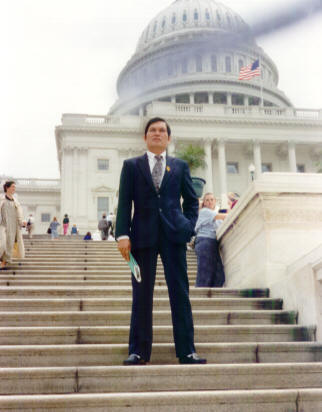
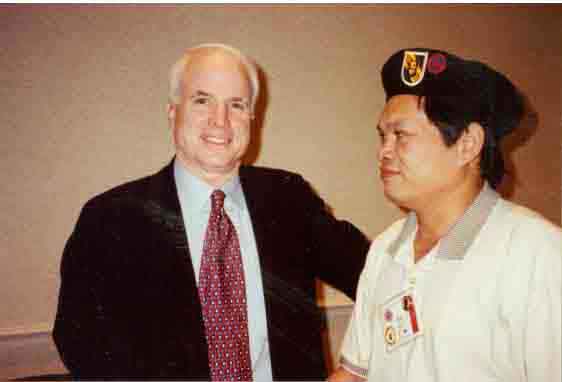
US Senator John McCain , Kim Âu Hà văn Sơn
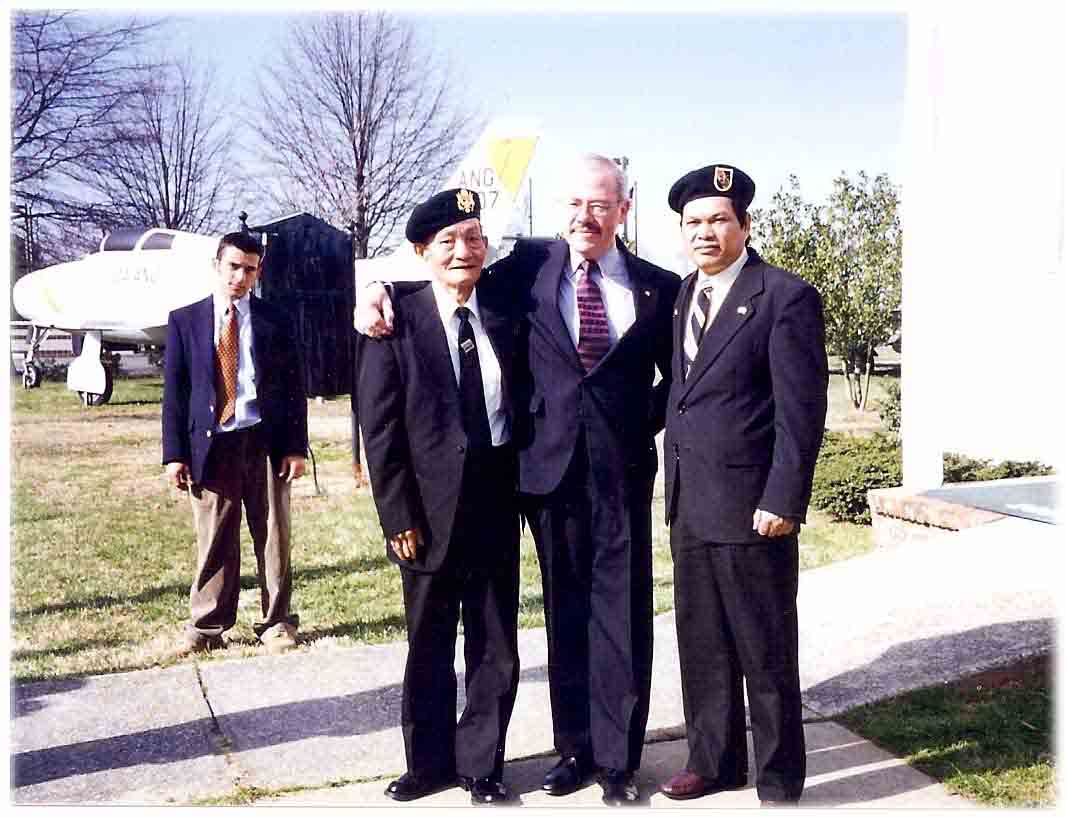
NT Kiên , UCV Bob Barr, Kim Âu Hà văn Sơn
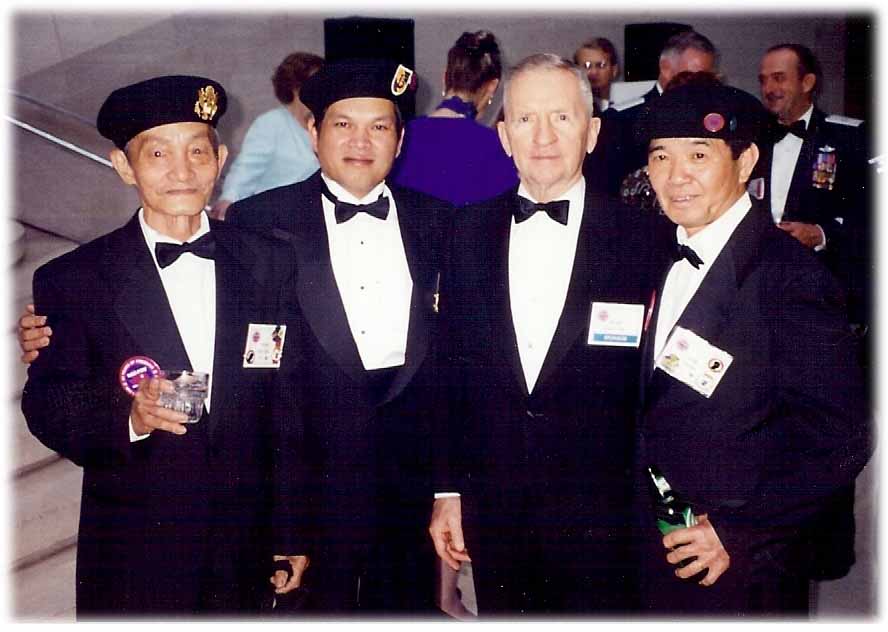
NT Kiên , Kim Âu Hà văn Sơn, Ross Perot Cố Vấn An Ninh Đặc Biệt của TT Reagan và NT Sám
 Welcome
